



Rot Society: Parlance #1
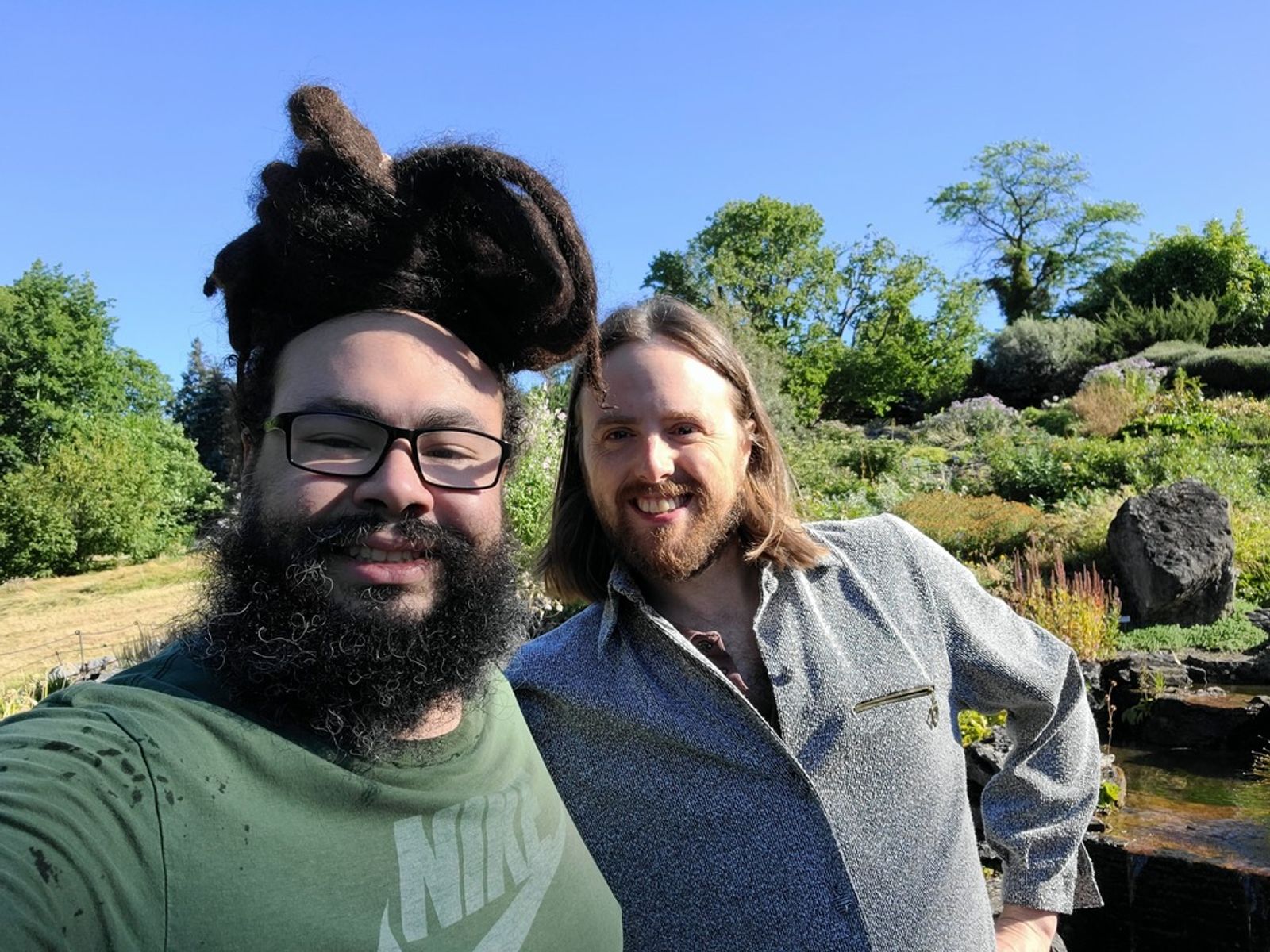
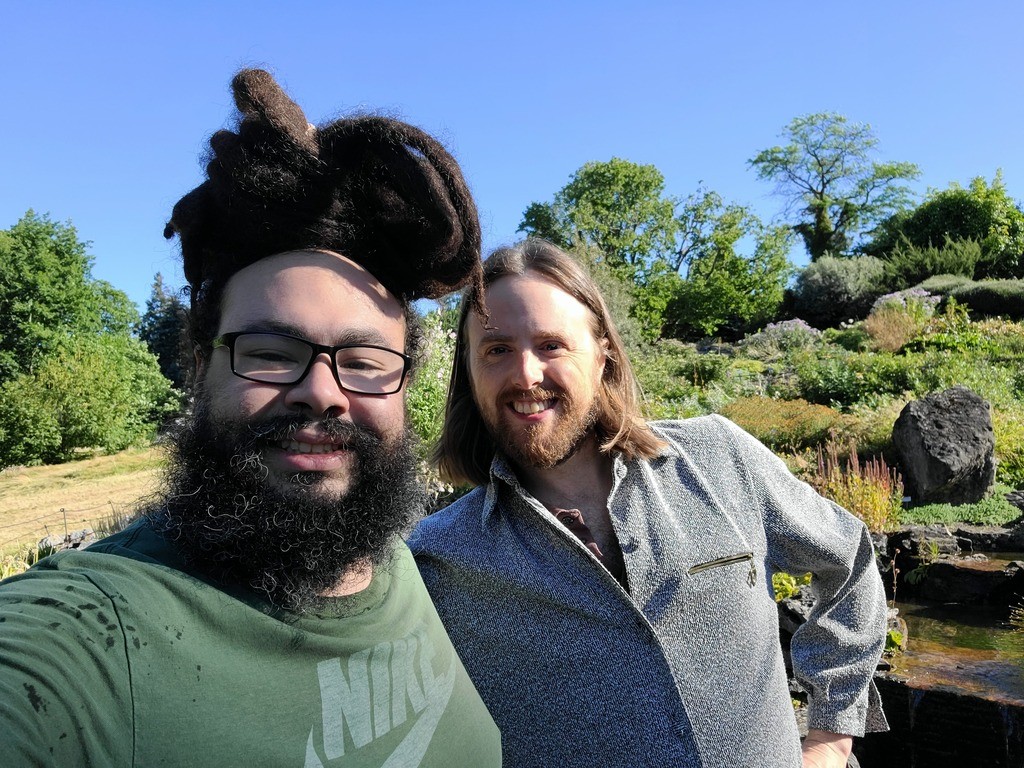
Transcript from public conversation taking place online between Harstad, Norway and Portland, Oregon, on May 29th 2025, facilitated by the organization home school.
John Andrew: Our project rot society references Don and Moki Cherry’s Organic Music Society, so it's situated in a post-1968, early seventies debate about ritual transformation of daily life, or life itself as the transformative ritual. There’s a friction between performance as practice, gesture, and ritual, versus performance as the communication of a work, or the communication of an idea that would exist separately from the practice. rot society explores decomposition. As a composer, I'd like to be able to use or activate this term: is there a tradition of decomposition? Can you (de)compose music? In recent works, I take Baroque music and find the border of the idea in it. A kind of Ship of Theseus: how much can I change before it loses its ostensible essence, becomes something else? That process has been really helpful. I've been looking for other analogs.
manuel arturo abreu: Julius Eastman’s organic music comes to mind. He was interested in accumulation and porosity, centering his compositions with an evolving anchor or essence that he called the prime. Eastman's (de)composition comes at it from the opposite angle– accretion rather than erasure– but I do wonder: does that principle of gathering, of agitation of what came before– this format of recursive porosity that Eastman was exploring– resonate with what you're describing?
John Andrew: Absolutely. For me the most interesting dichotomy in this history of decomposition is Julius Eastman on one side with organic music, and John Cage on the other with his deletion pieces. For example, Thirteen Harmonies (1976) takes these American hymns — four-voice chorales from the colonial era — and deletes notes to create a new piece.
abreu: You've performed these — you have an album.
John Andrew: Yeah, a couple, with Cop Tears— with guitar, flute, and bass. Not how it’s meant to be performed. And, well, Cage — he was really particular about how his music was performed.
abreu: Right. No porosity at all. He was very much about the charmed circle — the concept is a sacrosanct type, the performance is a token of the type. His compositions are abstract objects in the philosophical sense.
John Andrew: Exactly. It's all about the Ideal. For me, decomposition should reveal a body. I’m thinking of Gordon Matta-Clark: he’d excise a chunk from a building to reveal its materiality, to show its embeddedness in a landscape. But that's not Cage. You’d think deletion would reveal his music’s materiality, but it doesn't– if anything, he wants the gesture to shore up the composition’s conceptual borders. But in a way, Apartment House 1776 is good because Cage is wrong. If it's conceptual, then it doesn't really matter what notes you remove. And Cage said it didn't matter — but he was lying, because he still cared. It was still aesthetic, still material. And that's why Cage is an asshole.
abreu: Yes — not to mention Cage's contentious relationship with Eastman.
John Andrew: Yeah, absolutely. He hated performers. He hated the performer having agency.
abreu: He hated the body. Well, for me there are a number of angles to approach decomposition. Think about Rauschenberg's erasures — he did the Erased de Kooning Drawing (1953), and a series of white paintings (1951). Coming at it from my perspective as a visual artist and writer, the post-’68 frame is interesting, since a central tension in the western art world at that time is between conceptualism — all about the idea, about dematerialization — and then this emergence of minimalism, and the return of the body, the return of materiality and process, specificity. Some of these artists were straddling that boundary, of course. Robert Morris, Lee Lozano, Adrian Piper.
And Piper, like the others I mentioned, is a first-generation conceptualist, but the magic of her process– and recall that conceptualism is about exhausting permutations of a set of constraints– was that Piper used her body as the medium of exhaustion. So inherently, you're bringing in the messiness of process and performance, you're bringing in a degree of porosity. And Piper, with Food for the Spirit (1971), was thinking about her study as a work — basically documenting her process of reading Kant, because she's a philosopher as well as an artist and a yogi. So with this post-war moment, there's a tension between conceptualism and minimalism— perhaps bridged a bit by Fluxus and Zero in Amsterdam, and Umbra in downtown New York —that has yet to be resolved, a friction that's still worth exploring. Whether that's the body, or the notion of the organic.
I'm hearkening back to the original puns we were playing with when you were engaging with my notion of rot semantics, which explores decomposition in a semantic context. In linguistics, decomposition is the notion of breaking down a combinatorial object, like a sentence or a word, and analyzing the constituent parts to see how they connect. But of course it also ties into rot and decay, notions of nourishment, the life cycle.
John Andrew: Circling back to the Cherrys and Organic Music Society, there's something emerging in the friction between conceptualism and minimalism — a kind of non-correspondence, a coincidental relationship between the body and the idea. British philosopher Peter Osborne has this idea of the aesthetic remainder — no matter how idea-based a work is, there is something aesthetic left over, which can't fully be absorbed into the idea. And so in Piper's work it’s the body that remains.
abreu: The sweat.
John Andrew: Yes, exactly — the hair, the fingernails. There's a cruel inescapability. There's a kind of anger in it.
abreu: Ben Patterson comes to mind as well.
John Andrew: And this is why the first-generation conceptualists, and Black Fluxus artists like Patterson, are so interesting — there's this quality where Lick Piece (1962) is so much more in your face. For me, it's related to what Don Cherry was doing — this coincidental relationship between the idea and the aesthetic is really foregrounded. Don Cherry is literally playing both pop music and Penderecki.
abreu: The music has a non-idiomatic nature — what they’re playing is less important than the context or the materiality of that position. It relates in a way to notions of site-specificity. I’m thinking about this notion of free jazz and the trajectory of improvisation, not only towards Scandinavia, but toward life itself as opposed to music. The theater is life itself; the work is the living and the studying and the feeding people and hosting people in Tågarp.
John Andrew: The interdisciplinary, multimodal strength of jazz was huge in Scandinavia — somebody's painting, somebody's dancing, somebody's doing free jazz. The connection between dance and free improvisation is still really strong here. I think the history of jazz has that interdisciplinary element already– you had tap dancers in bebop clubs.
abreu: Of course — juke joints have dancers. Jazz and blues soundtracked chitlin circuit performance.
John Andrew: In Manhattan you had tap dance competitions in the same places, just as intense as bebop battles. They were just harder to record, so you don't have as much of a legacy of this improvised dance tradition. The paucity contributes to a tendency to simplify the jazz tradition. I cannot stand what Wynton Marsalis did — jazz as museum. Great musician, though.
abreu: There's a place for that kind of conservative revisionism. Jazz is wide. Of course jazz is about tradition, but also about the modern — that friction of transformation, porosity. There's a tension between a tired project of proving Black humanity or civility, and what I'm more interested in: radical experiments in living as improvisation, wayward living — as Saidiya Hartman puts it. I mean, situating things concretely with the Cherrys: In the context of Organic Music Society and Organic Music Theater, Moki really wanted Don to stop doing smack.
John Andrew: Yeah, absolutely.
abreu: For those ten years he was mostly sober, as I understand it, or perhaps we could say ‘California sober,’ and then he returned to the music scene proper in the eighties with the Codona trio — they have some great records, kind of considered early ‘world music.’ Thinking about this notion of improvisation and moving away from idioms of sounding to idioms of living — I think that's where Don and Moki were headed. It seems sustainable; they kept the Tågarp schoolhouse going for ten years.
John Andrew: Ten years is a lot in that time period. The western experiment of collective living happening in the sixties, and replacing opiates with psychedelics — that can potentially be hazardous. It can take the decompositional elements of improvisational living a bit far. Maybe they just didn't trust the fact that people have been doing this for thousands of years anyway. It's just living somewhere and singing. People do that and that's fine, that's folk music.
abreu: Western people are so disconnected from this kind of communal gathering situation. We have few infrastructures for collectivity anymore. As we’ve worked within the scope of rot society we’ve tried to find ways to build these spaces of collectivity in the west, and we must draw on the tools we have. Organic Music looks like one of those things we can draw from. It points to the limits or absurdity of the concept of ‘pure’ conceptualism.
John Andrew: One seems to need to use conceptualism against itself. For me, that's what Piper was doing — you draw attention to the body by creating this gap. This is why I like this idea of one of our sculptures solving a puzzle by dissolving it in hydrochloric acid. You take a puzzle and you just dissolve it. I like these ideas where the breaking down of the piece is also the making of the piece. It's a gesture. There's nothing wrong with allegory.
abreu: Yes, that piece is nice. But I don't know if I agree that nothing’s wrong with allegory. It depends whether you mean in art or in writing.
John Andrew: You think allegory can be okay in writing but not in art?
abreu: Yes — writing is ultimately allegory, unless you're doing it in a certain way. I find allegory in visual art… I don’t know. I prefer: do the thing, don't refer to the thing. I suppose that’s the minimalist in me.
John Andrew: Yes, that's why you dissolve the puzzle. Dissolving the puzzle is only an idea to a certain extent — it's also literally the act, and literally the dissolution of the idea. But I think it's simultaneous: it is dissolving the puzzle, and the audience sees the act, and it becomes a kind of doubling… Like how Adorno explains the mimesis between the idea and the act. You see an apple and in your head the word 'apple' comes to mind, and when somebody says 'apple,' the thing comes to mind. There's a natural mimesis. And when you go too far with conceptual art, you lose this mimetic relationship.
abreu: Right. Rizvana Bradley talks about obdurate materiality, or the Black residuum — that excess or remainder that you can never do away with. For example, we are disciplined to separate reading and looking, and to treat writing as dematerialized. But it’s an agitation of a surface. It builds up an excess (this conversation, for example).
John Andrew: What I see in the conceptual traditions is a refusal to fully incorporate this irreducible remainder. That reminds me of Ayesha’s work— think about the gap between Shasta Geaux Pop, her pop alter ego, all spectacle and excess, and then her actual permaculture practice, literally growing food. The performance and the subsistence don't reconcile into a tidy whole; you've got the persona on one side and the soil on the other, and the work is in refusing to collapse them.
abreu: Exactly. In the contemporary context we talk about the poetics of conceptualism — yes, we're working with ideas, exhausting constraints, dematerializing, but we also have to accept that there's a social meaning to these actions. An allegorical excrescence, if you will. That irreducibility is there. It can never be fully idealized or dematerialized.
John Andrew: Material excess — it can never be fully turned into a dematerialized concept.
Abreu: Right — hence, you don't need to do anything allegorical in the art itself, because it's inherently part of the poetics of conceptualism.
John Andrew: This reminds me of a conversation we had about the kind of arbitrary nature of some of the Organic Music Society recordings — it could be a raga, it could be a pop song, it could be really aggressive improvisations that make no sense.
abreu: It could be a drone. And for some reason it all works.
John Andrew: Because it's all excessive. Using a kind of trite metaphor — it's like the flower that comes out of the plant. The music is the result of their way of living, it’s what they do with their surplus energy. The important thing is that they're living together, producing energy, eating food together, having and caring for kids. And then you have your excess energy — your joy — and you put that into the music, the performance, the textile work.
abreu: When I listen to Organic Music Society recordings, I keep reminding myself that I’m listening to the recording of a social situation— and it happens to include a performance of music. It's interesting — is it performance? I guess it is performance.
John Andrew: Right, what do we mean by performance? If the home is a stage and the stage is a home, then it is performance — and cooking is also performance. So maybe I'm wrong, and maybe the music isn't excess, because it kind of destroys the boundary between what is necessary and what is art.
abreu: Well, what's the difference between excess and essence? There are different social situations. The project’s initiating performance — the 1972 Chateauvallon one with the trapeze artists and kids on stage, is fully a social situation. Whereas the 1973 LP released by Caprice, which was still a social context, had them performing for an engineer who was recording them. And that's different again from the recordings of the study sessions on improvisation and silence that Don did (The Summer House Sessions, 1968). Those sound like free jazz — they were with professional musicians, people with training and interest in avant-garde traditions. So there are different social spheres that this project moves through. I'm listening to a social situation. Music happens to be a part of it. Is it excess, or essence? Decomposition may give us a way to bridge those two somehow. Essence can become excess, excess can become essence. There's a dialectic there.
John Andrew: Excess as essence… One of the themes we always come back to is Javon’s deep knowledge of sugar. As a “dessert ingredient” it’s technically an “excess” to what we need to eat, but it’s become the most essential part of Jamaican culture, but not just in terms of “how Jamaicans experience culture”, since it’s also literally shaping bodies, and also causing national issues with diabetes, not to mention the historical realities of triangle trade linking sugar and slavery (not to mention Norwegian cod).
abreu: That reminds me of Sylvia Wynter's "Novel and History, Plot and Plantation" — she explores the ambivalence of the modern European novel, as both product(ive) of market forces and zone of resistance to it, and draws analogy to the dialectic of the plantation and the master-allotted provision grounds, the plot where the enslaved grew their own food and where a folk system of African and Indigenous values survived as a syncretic, secret remainder against the plantation logic– yet both are organized around the market value of cane, tobacco, etc as export commodities, since the provision grounds are alloted by the master. Again we keep seeing how this kind of double/outside structure is essential to survival. Wynter argues that in the end, ambivalence may be what "saves" us, which is intriguing.
Have you heard of Gustav Metzger?
John Andrew: Sounds familiar? A theologian?
Abreu: Haha, no way. He was a stateless Jewish artist who explored the notion of auto-destructive art: works produced in a way that they destroy themselves over time. It's a bit allegorical, but it's also literally artwork that destroys itself, so it's impossible to collect his work. They find ways of documenting processes — which again goes back to this question of documenting a social situation.
John Andrew: Yeah, auto-destructive and decompositional seem to have some sort of connection.
abreu: And in our case, the auto-destructiveness is more about generating a nourishing process — where rot and decay are part of nourishment, part of a life cycle or social development.
John Andrew: I've been up here in Harstad recording with Lasse Marhaug, a Norwegian noise icon. He grew up with all the black metal people — he knew Mayhem and things like that. And he played with Mats Gustafsson. He bridges many different genres. But what I'm thinking about is the difference between Gordon Matta-Clark cutting a hole in a building before it's going to be demolished — and then Burzum or someone burning down a church.
abreu: The church burnings were social environments. People gathered to burn parts of Scandinavian tradition. Of course, we don't condone this, but–
John Andrew: Right, But it's a mark of how alienated western people are from folk culture — that in order to make folk culture social, you have to burn it down. A complete reversal.
abreu: But really, it's also just what folk culture was doing anyway — the bonfire, dancing around the bonfire, gathering together to make art as creating a space for social interaction.
What's it like recording with Lasse?
John Andrew: He loves photography. He would use one mic at a time in one location — we were in the world's northernmost medieval church. A really beautiful, old building. He'd arrive with a weird microphone and place it somewhere, like taking a photograph — just record me from this one spot. Rather than a focus on “fidelity”, for example mixing down multiple specifically-placed studio mic recordings to create one “objective” image, it’s this question of: what does this microphone sound like in this place? And making the album will be like juxtaposing these different images.
abreu: Super lo-fi. Very black metal — the minimalism of it. The whole thing with black metal was intentionally making it sound as shitty as possible. This anti-aesthetic that's supposed to evoke some kind of experience. I was (maybe unfortunately) deeply influenced by black metal growing up, notions of extremity and lo-fi aesthetics. I was experiencing so much of this stuff through pirate networks, YouTube, random fan forums. This weird thing of highly antisocial, disturbed people gathering socially around this lo-fi experience. The lo-fi aesthetic was tied to portability, access, and sociality for me— you download some of these videos and they're like 50mb. In the dial-up days that would only take a couple hours to share. And when you strip away fidelity that way, it's almost a Marshall McLuhan thing —this idea of hearing the essence of a medium, whether it's the crackle of vinyl or the screech of an overcompressed digital file. You can maybe get to that by stripping away fidelity and working in these glitchy ways.
John Andrew: A lot of music made now is made for recording, not to create a social space. But that doesn't mean it can't be social, and it doesn't mean it can't be centered around the materiality of the medium — like film, where the shape of the lens, the width of the lens, so many material factors create an artifact that's then shared.
abreu: And mediums don't necessarily have essences, right? Maybe McLuhan meant more the characteristic experience associated with specific media. The vinyl crackle comes from repeated plays — it's a matter of accumulation and decay. You don't hear it when you first buy it.
John Andrew: The essence is discovered in the social practice.
abreu: In the process, exactly. So what is the essence of an idea in conceptualism? It's how it's used, how it's habitually understood. In art, that’s the realization the early minimalists, and certain first-generation conceptualists, had.
John Andrew: The idea of some original intention — that's really boring. But in terms of social practice, that's when you actually get into recognizing a character in something. The essence is performed.
abreu: Essence emerges in process. We can bring in Wittgenstein — it's about family resemblances. This performance of identification and resonances and similarities. Let me break it down a bit— British eugenicist Francis Galton invented composite portraiture because he was interested in racist pseudosciences like physiognomy and phrenology, notions of human types. Composite portraiture was a way of inventing a mean phenotype. He basically invented Photoshop. And, inspired by composite portraiture, family resemblance is Wittgenstein’s way of describing how we categorize things as part of the same concept, members of the same set: we see closer and more distant relations based on resemblance. So it’s like when you look at photos of a family and see: oh, that nose is the same as the uncle's, the eyebrows are the same as the grandfather's — that kind of thing.
John Andrew: But what's interesting is that it's not necessarily linear — it's not genetic. It's a discovery process. All the pieces are on the board — it's mix-and-match phenotypes that already exist. It's Baroque in a way.
abreu: Wittgenstein thought identifying family resemblances was a way to define a given category — like, what is an idea? We see various commonalities among certain immaterial and abstract phenomena, and we call them 'ideas.' He said: this identification process is a game. 'Game' itself is an example of family resemblance — there are so many different kinds of things we call games, and the only way to group them is through a discovery process: finding and grouping the types of resemblances, dealing with edge cases. A creative process, ultimately. Thus, for him, the best way to describe language is: it's a game. It's a rule-based system. It has to do with use and convention. And it's public, not private. Quite radical for its time. And I'm interested etymologically in the fact that this Austrian Jewish man is looking at this British eugenicist's notions. Not that Galton’s ideas can be laundered or something, but that we desperately need to contend with the evil origin of certain fundamental ideas in the sciences and philosophy.
John Andrew: Yeah. Family resemblance is a nonlinear way of dealing with classification. When you think of family resemblance in terms of what is useful — how do we relate A to B? All the pieces are already on the board, so to speak.
abreu: It’s a salience problem. You come to the game board with conventions already indoctrinated into you, ideologies that influence your idea of who or what matters, of who or what is useful.
John Andrew: Salience? Or you just come with the hydrochloric acid you dump on the pieces.